How Is Invisalign® for Teens Different Than Invisalign® for Adults?
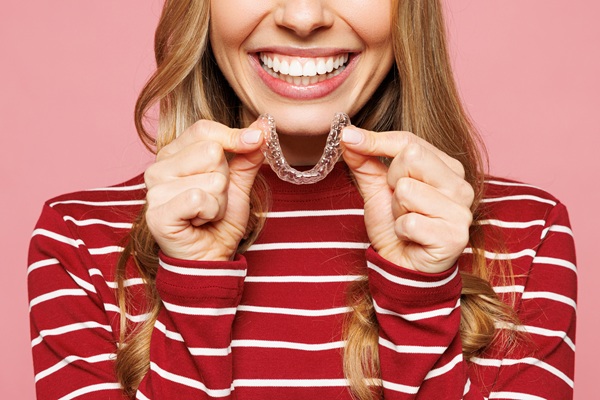
Invisalign® for teens is a discreet treatment that corrects mild and moderate orthodontic issues. Clear braces are an aesthetic upgrade to the metallic look of traditional braces. This quality is the same reason that adults choose Invisalign to straighten their teeth. Like image-conscious teens, adults who would otherwise forego orthodontic treatment can improve their smile without drawing attention to their teeth. There are several more similarities between the type of Invisalign that teenagers use and the type that adults use.
Understanding the Invisalign treatment process
Orthodontic treatments like clear aligners work by applying constant, gentle pressure to reposition the teeth and the structures that anchor them. This applies to all Invisalign variations.
The process of Invisalign treatment is similar for teens and adults alike. An orthodontist will perform a thorough exam of the patient’s mouth. Then, they will take intraoral scans and X-rays, which they will use to map out the current position of the teeth. The orthodontist will feed the images into software that assembles the scans and X-rays to make a 3D model of the patient’s mouth. Finally, they will use the software to make small, incremental changes to individual teeth in the model.
Each set of changes serves as the blueprint for a custom dental tray that applies gentle pressure to specific teeth. The orthodontist will design a series of these blueprints, with each new set building on the previous one. In the end, the dentist will have approximately 8 sets of clear aligners. This holds for all types of Invisalign. With so much in common, is there any difference between Invisalign for teens and Invisalign for adults?
Comparing Invisalign for teens and Invisalign for adults
Invisalign for teens: an emphasis on responsibility
Teenagers will have to take off their aligners for sports, meals, or snacks. They may forget to wear them afterward. This is where an indicator light comes in. Ideally, clear aligners need to remain on the teeth for 22 hours if they are to straighten the teeth on schedule.
Now, the indicator will display different colors depending on how long they stay in the wearer’s mouth. For example, a white light means that the teen is wearing their aligners for around 22 hours a day. Meanwhile, a blue light indicates that the teen needs to be more responsible and wear their aligners more often.
The light is a visual aid that helps the teen track their discipline and progress. It is a simple hack that helps to keep the teen’s attention on their orthodontic treatment. With time, the teen can form a habit of following the instructions of their dentist. Adult Invisalign does not come with lights.
More aligners as part of the treatment plan
Teenagers are more likely to lose or break their aligners. Their orthodontist anticipates this possibility by adding a few extra aligners to the treatment plans of their young patient. The orthodontist will implement small changes from one set of Invisalign trays to the next. In contrast, adults typically need fewer sets of Invisalign trays than teenagers.
Take a hassle-free journey to a new smile
Clear aligners like Invisalign for teens can give your teen a confident, well-aligned smile without metal braces. Do you have questions for the Brea Pediatric Dental Practice and Orthodontics team? Call our office today to learn more or to schedule a consultation.
Request an appointment here: https://www.breapediatricdentists.com or call Brea Pediatric Dental Practice and Orthodontics at (714) 782-0215 for an appointment in our Brea office.
Check out what others are saying about our dental services on Yelp: Invisalign for Teens in Brea, CA.
Related Posts
As a parent, you need to visit the orthodontist to know the necessary precautions to take and ensure that the child's jaw grows healthy and without issues. The soft tissue and muscles of the face play a role in proper jaw development. When the soft tissue or muscle is damaged, it leads to bad habits,…
The primary goal of early orthodontic treatment is to prevent and fix bite misalignments. Several causes, including genetics, the premature loss of primary (baby) teeth, and harmful oral habits (like thumb sucking) may lead to such anomalies. Orthodontic abnormalities might be congenital or occur during early childhood. Straight teeth can reduce the incidence of dental…
A kids orthodontist supports oral development through early orthodontic treatment. Children can visit these dental providers earlier than many families anticipate, and having answers to key questions can make the process feel far less overwhelming. With modern technology, a kid-friendly atmosphere, and thoughtful timing, the experience becomes one of education and proactive care. Orthodontic treatment…
A pediatric dentist can restore comfort and function to a child’s tooth that is affected by dental trauma or decay. Often, baby root canals can preserve the natural tooth until it is ready to fall out on its own. A tooth extraction is, however, a better choice if the tooth is damaged beyond repair. A…